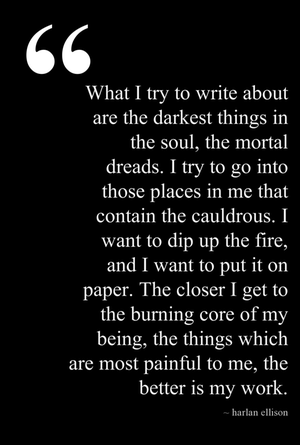
Dip Up the Fire and Put It On Paper
Tagged with: Harlan Ellison, motivation to write, power of words, quotes, storytelling, writing advice, writing quotes
Posted in Quotes
Posted in Quotes
Book Review: “Outlining Your Novel” by K.M. Weiland
The following book review was originally published in SouthWest Sage, December 2013, and is reprinted here by permission of the author.
Outlining Your Novel: Map Your Way to Success by K.M. Weiland
A Book Review by A.R. Aeby
 J.K. Rowling spent years plotting out the Harry Potter series. J.R.R. Tolkien had the curious habit of starting over whenever he hit a snag in his writing. Earnest Hemingway had a noted love affair with the bottle that directly influenced his life and writing. And at some point each of these acclaimed writers needed to sit down and take the story that was swimming around in their head and commit it to paper. How they made it through the process with a fully fleshed out and dynamic novel only they can tell you. But it is a universal step for all writers. At some point, you as a writer will have to figure out what process works best for you to transfer the story idea from your mind and make it into an actual book. In Outlining Your Novel, Weiland provides basic tools to create a roadmap for your story to follow.
As I sat down to read Outlining Your Novel, I was ready to be told the virtues of outlining—as even the least discerning person could expect from the title. I, of course, already thought I knew the merits of this process for story creation. As an outlining fan, all I really expected was a little ego stroking with the knowledge I have been doing it right—at least this part—all along and that the whole pantsing method (basically writing from the seat of your pants) was the doom of writers the world over. Now, before you start getting all judgey, let me just say at times we all need to hang onto that one thing we get right to keep us moving forward, and the fill-in-the-blank outlining process is mine. After that everything else about my writing is kind of a crap shoot. However, Weiland had more to say about outlining than I expected. She showed me that it was more than dry Roman numerals, stark words and my usual methods. Outlining is actually a very useful tool that can be shaped to fit your own style and taste. With her suggestions even the most free-spirited writer can have focus, and we type “A” personalities can introduce a little more flexibility.
The right method for the individual writer is not a one-size-fits-all, and Weiland openly strives to help you find yours. From detailed outlines to a short reference page, mind maps to post-its on a wall, the right way to outline is what works best for you. When you sit down to outline, the idea is to be focused, but to avoid rigid adherence to the outline. Weiland advocates structure, but also makes allowances for change and organic writing to be included. The obvious benefits of preplanning include avoiding those nasty story holes, dead ends and other unsightly things that will take away from or ruin your story. The end goal of outlining is to have your story, characters, and plot fully thought out and planned so the actual writing is the easy part.
This book is very manageable at less than 200 pages, a fairly quick and easy read but still thorough. Weiland is incredibly well organized—as to be expected—with a clear, concise and straightforward writing style. I wouldn’t call this book dry or boring by any means, but just a warning: it is not written to entertain, just inform. I love that the chapters are outlined in the table of contents. She gives point-by-point explanation of different tools and approaches for customization, while providing a multitude of examples, especially from her own process as a writer. She even mentions appropriate times for pantsing, like when you get stuck. The sections interviewing other published authors on their process—such as Becky Levine, Aggie Villanueva, and John Robinson—really helped me rethink what can be improved in my own process and ways to develop the weaker areas. She also mentions some writing programs and internet tools that were new to me, and I look forward to utilizing them.
I have to say this wouldn’t be a great first how-to for writing. Having a good grasp on story construction is fairly key, and some ideas about character construction along with an actual story idea are needed before diving into the outline. I suggest giving this book a thorough reading before trying to apply it to a particular project.
K.M. Weiland is active as both a mentor to other authors and a published author. Her other writing book Structuring Your Novel: Essential Keys for Writing an Outstanding Story and her website Helping Writers Become Authors are very nice accompaniments to this book. Weiland also has an instructional CD called Conquering Writer’s Block and Summoning Inspiration. She is a writer of speculative and historical fiction. Among her credits are A Man Called Outlaw, Behold the Dawn, and Dreamlander.
The creation process is a very individual thing. What worked for J.K. Rowling, J.R.R. Tolkien, and Earnest Hemingway probably won’t work for you—especially that whole love affair with the bottle thing. But as a writer, finding the right process for you is a crucial step to becoming an author. This process is ever evolving over the life of your career, and Outlining Your Novel will help give you new ideas and refine old ones so you can have the novel of your dreams.
 A.R. Aeby received a Bachelor of Arts in history almost solely from the love of stories, even nonfiction ones. She is the author of the book review blog Whymsy Likes Books, where her goal is simply to share her passion for books. But she is a book author with the eternal hope of becoming a published book author. She lives in the deserts of New Mexico with her two young daughters and her husband of ten years. Visit her blog at http://whymsylikesbooks.blogspot.com.
Tagged with: A.R. Aeby, Helping Writers Become Authors, K.M. Weiland, Outlining Your Novel, pantsing, Whymsy Likes Books, writing tools
Posted in Book Reviews
Posted in Book Reviews
Speculative Fiction Writing Contests: 2nd Quarter
Do a Google search for writing contests and you’ll find over 44 million results. That huge pool of general fiction contests is one reason I don’t submit my work to them anymore — the thought of my speculative fiction entry getting lost among thousands is depressing. And really, would my genre submissions be taken seriously in such competitions? Here are four contests that will place your short story in a smaller group of other science fiction, fantasy and horror submissions to be judged by those who understand these genres. Deadlines are in the second quarter of the year. These are free or low-fee contests, with one of them paying industry-standard rates to the grand prize winner.
 Albedo One, Ireland’s Magazine of Science Fiction, Fantasy & Horror, announces the 9th International Aeon Award Short Fiction Contest. Entries in science fiction, fantasy or horror genres up to 10,000 words. Contest runs from January 1 through November 30 with four rounds (or quarters) throughout the year. Deadlines: March 31, June 30, September 30, November 30 – but enter anytime because submissions that miss a deadline (except the final one) go into the next quarter and multiple entries are allowed throughout the competition. The best submissions are chosen from each quarter and shortlisted for consideration for three prizes at the end of the year. Entry fee: €7.50. Grand prize: €1000; second prize: €200; third prize: €100, plus place winners are published in Albedo One.
 The inaugural Baen Fantasy Adventure Award will be given to the best piece of original short fiction that captures the spirit and tradition of such great storytellers as Larry Correia, Robert E. Howard, Mercedes Lackey, Elizabeth Moon, Andre Norton, J.R.R. Tolkien, David Weber and Marion Zimmer Bradley. Short stories up to 8,000 words. All fantasy genres accepted. No reprints. No entry fee – but only one submission per person. Grand prize winner will be published on the Baen Books main website and paid at industry-standard rates for professional story submittals. Grand Prize, second and third place winners receive a prize package containing various Baen Books. Deadline: June 30, 2014.
 British Fantasy Society Short Story Competition accepts stories up to 5,000 words written in English, previously unpublished, not under consideration elsewhere. Any kind of fantastical story – fantasy, science fiction, horror, supernatural, fabulation, magic realism, slipstream, etc. or any combination of those genres. Open to BFS members and nonmembers. Nonmembers pay £5 entry fee. 1st prize: £100. 2nd prize: £50. First and second place receive a year’s BFS membership and publication in the BFS Journal. 3rd prize: £20 and publication in the BFS Journal. Deadline: June 30, 2014.
 Writers of the Future Contest is open to new and amateur writers of unpublished science fiction or fantasy short stories or novelettes up to 17,000 words. Entrants retain all publication rights. Prizes are awarded every three months: $1,000, $750, $500. Quarterly first-place winners are eligible for the Annual Grand Prize of $5,000. No entry fee. Current quarterly deadline: June 30, 2014.
Good Luck! And let me know of other spec fic contests I can add to the list.
Tagged with: Aeon Award, Albedo One, Baen Books, Baen Fantasy Adventure Award, British Fantasy Society, British Fantasy Society Short Story Competition, Contests, courage to write, fantasy, judging a writer's progress, motivation to write, science fiction, Speculative Fiction, speculative fiction writers, speculative fiction writing contest, Writers of the Future Contest, writing contests
Posted in Writing Contests
Posted in Writing Contests
Mary Haarmeyer Talks Screenwriting, Part II
Producer, director, and writer Mary Haarmeyer continues her discussion of screenwriting in this second of a two-part interview. Mary has won awards for her scripts since 2007, including first place in the screenplay category of the 2010 SouthWest Writers Annual Writing Competition. Active in the workings of ReelFlicks Productions and T-RO Films, she is currently in post-production of Hunter’s Game, a paranormal/thriller television pilot filmed in New Mexico. Find out more about the series at www.huntersgame.tv and more about Mary and the crew on the T-RO website at www.t-rofilms.com. Click here to read the first part of this interview.
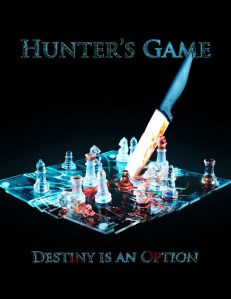 How did producing and directing Hunter’s Game differ from your previous projects?
With this project I wanted to give other striving artists a chance to succeed as well. I’ve been a successful business owner for 29 years and have always been able to figure ways around obstacles. With film, you must have talent, but you also need connections and sometimes just plain dumb luck. Being a first-time director/producer on a major project, I sought out people like me, who had talent, but who had not gotten the breaks to be in leadership roles. There was a stiff learning curve, but in the end we grew from this experience, and if given the chance to continue on with this series, we will all continue to grow and excel.
You are an advocate for making films in New Mexico, using local film crews and actors when possible. What does New Mexico offer to the film industry?
I believe New Mexico has an incredible talent pool here. Not only are our colleges turning out top-notch film crews, we have acting coaches and classes building up the talent pool of actors, as well. New Mexico also has a very diverse landscape. Albuquerque alone goes from desert, to mountains, to rivers, to forest in just 30 miles in any direction, not to mention all the amazing locations all over the state. And New Mexico is one of the best states for tax incentives coming in at 25 percent for a feature film and 30 percent for a television series. We also have various studios in Albuquerque and Santa Fe.
How can studying screenwriting techniques help fiction writers improve their craft?
Studying great scripts can show you the blueprint for structure and storytelling techniques. Script writing is different from novel writing in that novels allow you the luxury of space to elaborate on description, but in screenwriting you have limited space and you must cut your narrative down to the bare bones. In screenwriting, you must use the least but most powerful words to tell your story in as little as 95-110 pages.
What skills do fiction or nonfiction writers already possess that will help them in writing screenplays?
Discipline in finishing their projects and the willingness to continue to do rewrites until the project is as close to perfection as possible.
What is your ideal list of ingredients for a screenwriter?
♦ Education: Learn the rules of screenwriting. If your script does not meet current market standards, it will not be read. The rules change often, so make sure your script is market ready. There are numerous classes and workshops available online and at universities. I would also recommend books such as Story by Robert McKee, Save the Cat and Save the Cat Strikes Back by Blake Snyder and The Screenwriter’s Bible by David Trottier, but these are only a few of the great books out there.
♦ Writing Skills: Scripts with technical and grammatical errors are thrown out before they ever reach the desk of decision makers. Make sure your story is the best it can be before submitting it. You have a great story, so make sure it is presented in the right format, content, and package to insure it gets read.
♦ People Skills: With screenwriting, you not only have to be a great writer, you also need to have great people skills. These days you must market your work as well as yourself in order to sell a script.
♦ Personality/disposition: Flexibility is the number one trait I would say you need in working in film. In the film industry, you need a positive attitude along with an open mind. Film is a collaborative effort. When your story is sold, you will become part of a production team and must be willing to make changes due to budget, time constraints, location restraints, and the desires of the above-the-line production crew (and even actors). When working with a group of diversely talented individuals, it is almost always necessary for the writer to compromise on some aspect of their script.
♦ Other: Again, there are always exceptions to the rules, and if you have the ability to produce, write and direct your own production, then you will maintain control of your script and the creative outcome. But be warned, as the director and producer, you will also find that things such as budget constraints, location problems and cast and crew availability might force you to make concessions on your own story as well.

Mary Haarmeyer: Producer, Director, Screenwriter
Any new or ongoing projects you can tell us about?
I’m still busy marketing Hunter’s Game, the TV series completed by our production team T-RO Films, LLC. We hope to keep the project in New Mexico with New Mexican crews and actors at the forefront. Going forward this year, I need to complete the writing of the next eleven episodes of Hunter’s Game, as well as write three comics and two novels in order to help with the trans-media marketing of the show. There are other scripts in the works, as well.
What other advice do you have for writers?
In order to see your novel on the shelf or your film on the big screen, you first must write it. Do not let that blank page or blinking screen defeat you. There are stories within your imagination that only you can tell with a voice that is distinctly yours. So write, rewrite, perfect, then get out there and make your vision a reality!
Tagged with: Albuquerque, Hunter's Game, Mary Haarmeyer, New Mexico, New Mexico Film Industry, paranormal, ReelFlicks Productions, Santa Fe, Save the Cat, screenwriting, screenwriting success, SouthWest Writers Writing Contest, T-RO Films, tax incentives for films, tax incentives for television, tax incentives in New Mexico, television pilot, The Screenwriter's Bible
Posted in Author Interviews
Posted in Author Interviews
A Writer Is…
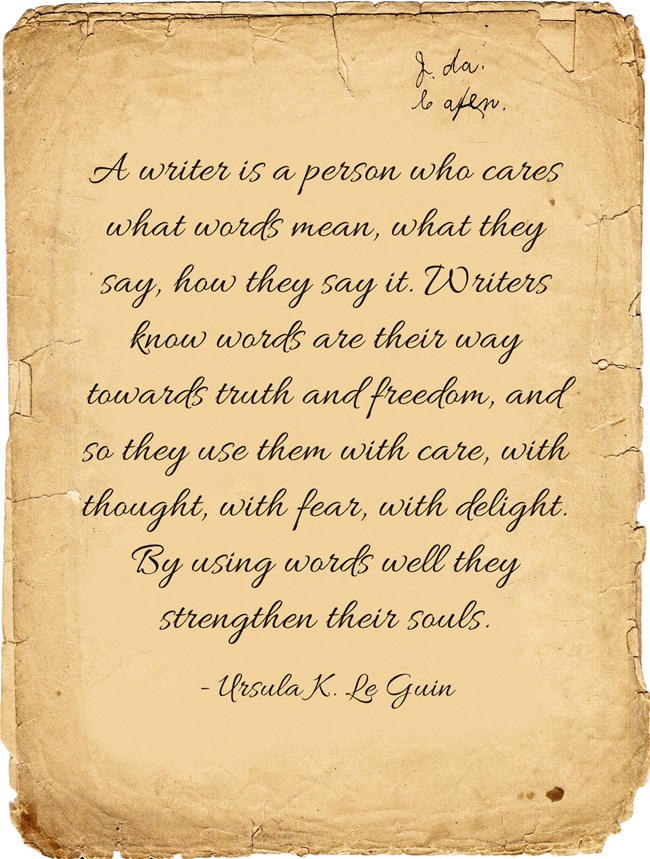
Tagged with: power of words, Ursula K. Le Guin, writer's responsibility, writing quotes
Posted in Quotes
Posted in Quotes
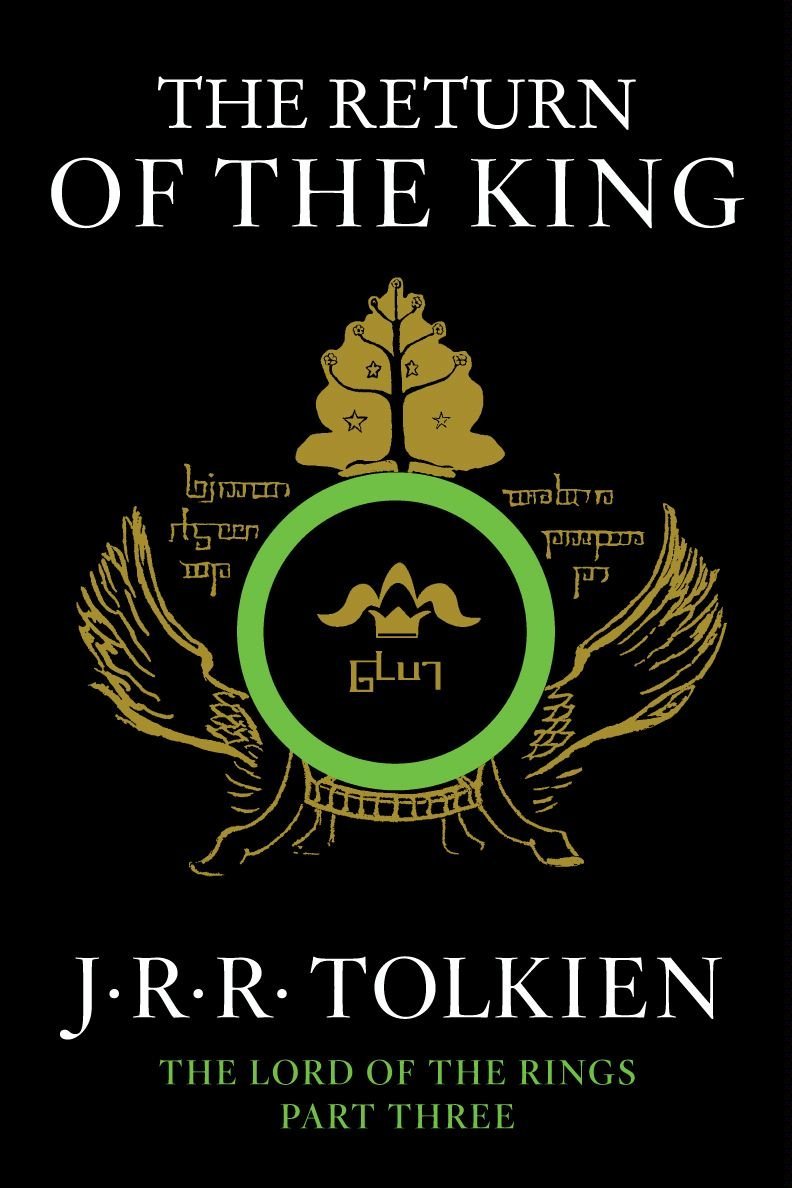
Book Covers Then & Now: The Lord of the Rings
J.R.R. Tolkien’s The Lord of the Rings novels (as well as The Hobbit) have been my favorite books since I first discovered The Fellowship of the Ring back in 1969. I brought the set down from the shelf the other day and decided to compare the scanned copies of these old covers with some of the newer ones issued over the years. You can probably tell by the condition of the first covers in the rows below just how often I read this set. If you look closely you’ll also note the cost of these mass market paperbacks at just .95 each. The book covers on this post are only a few examples of the many issued since the first printing in 1965. Go to Adazing.com for a more thorough list through 2002.

1971
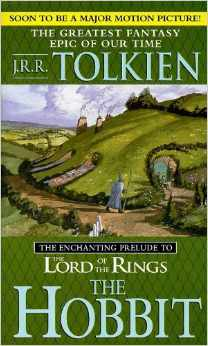
1991
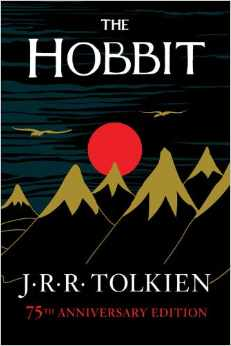
Reissue 2012

2013

1969
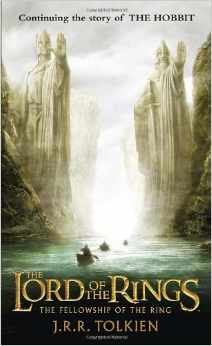
1986

2005
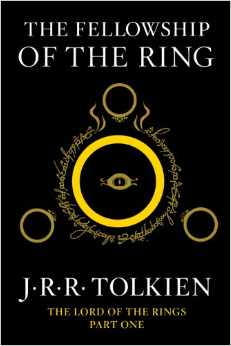
Reissue 2012

1970
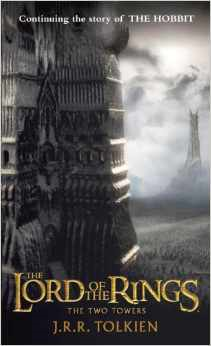
1986
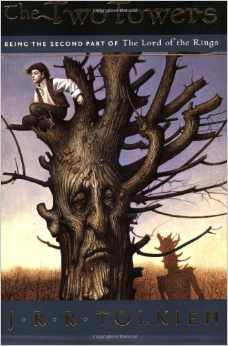
2005

Reissue 2012

1972
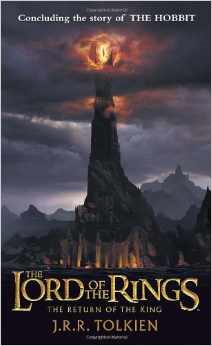
1986

2005
Reissue 2012
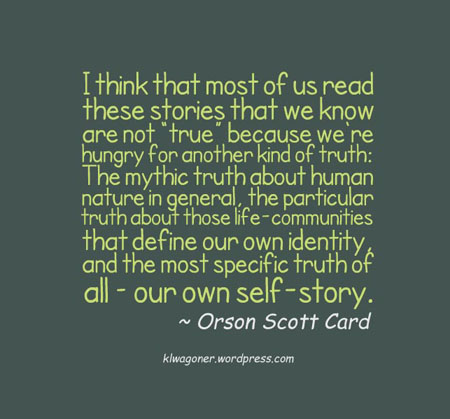
Why We Read Fiction
Tagged with: human nature, mythic truth, Orson Scott Card, speculative fiction readers, truth in story, writing quotes
Posted in Quotes
Posted in Quotes
Puppet Strings: Mercy Killing & Murder on “The 100″
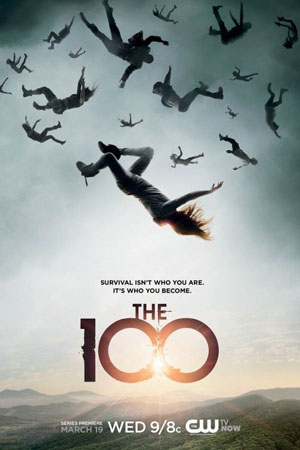 In The CW’s new series “The 100,” a group of juvenile prisoners are secretly exiled from a dying Ark – 12 linked space stations housing the survivors of nuclear holocaust – and onto Earth’s surface to test if our planet is habitable again. Though I’m not in the typical demographic for this show, I’ve always enjoyed post-apocalyptic stories of ordinary people fighting to come out ahead against a fierce environment and the conflicts that arise within themselves and between others.
As a writer I appreciate how the show has created strong characters, dividing them into opposing factions, all fighting multiple enemies from within and without. Some are likeable, some not. True to the show’s tagline – Survival isn’t who you are. It’s who you become. – we see characters changing after only a few episodes. Gray areas are beginning to smudge the lines between good and bad, right and wrong.
Also as a writer, I’m aware of the need for throwing in complications, adding hooks and cliffhangers, planting clues, using backstory. These are elements writers use to tell a story and keep a reader or viewer engaged. But the best stories are those told as if they’re telling themselves, not as if someone else is telling them. In other words, we should not see the puppet master manipulate the strings.
Episode three “Earth Kills” took me by surprise (perhaps if I’d noticed the title ahead of time I could have prepared myself). But I wasn’t bothered by the act of the mercy killing and murder included in the episode. I see plenty of blood and guts while cringing my way through “The Walking Dead.” I suppose if someone I knew had suffered for hours under the onslaught of acid rain and then begged to be killed, I might comply. No, my problem came later when 13-year-old Charlotte murders Wells, an important character who had just been redeemed in viewers’ eyes and proved himself to be the best kind of friend.
I can overlook teenagers who race through a forest without showing signs of fatigue even though they had lived their lives confined in a space station (must have been those strong, energetic teen bodies). And let it slide when a river monster lets a character go free when the creature should have torn the girl to pieces (it got confused or she tasted bad). Or accept that a fatal spear wound to the chest could be healed by unusual herbs (irradiated herbs after all). But…in Charlotte’s case, not enough time was devoted to showing her fall into a mental abyss. Even though we see her suffer from nightmares of her parents’ death, sleep deprivation, hunger, and isolation, it still wasn’t enough to justify her actions in the final scene. It might have worked for me if the writers had given it one more episode to show her dealing with these issues, as well as her declining mental state. As it is, Charlotte witnesses a mercy killing and learns the mantra “kill your demons” – and then proceeds to murder Wells because his father killed her parents. I was stunned. I did not see it coming.
What science fiction does best is apply the “what ifs” to a storyline to help us consider what it is to be human through the lives of characters thrown into every sort of situation. These kinds of stories unfold naturally from scene to scene, each one building on the other. With this episode of “The 100” I saw writers tossing plot lines around trying to complicate and maneuver for shock value and to make viewers believe that not even their favorite character is safe. I saw, too clearly, the puppet strings.
Now I have to decide if I’ll continue to watch the rest of the series.
Final note: I am disappointed that Wells is gone, but maybe he could pull a Spock thing and come back to life – but not actually as Spock because that would just be silly, but maybe those healing herbs could seep into Wells body and reanimate him, like, maybe…a zombie, but not actually a zombie because that would just be silly, too, but maybe Wells could just wake up surrounded by glowing butterflies, because the butterflies have healing powers, too, and it was, after all, just a dream….
Tagged with: characters, manipulation in writing, mercy killing, post-apocalyptic, storytelling, suspension of disbelief, The 100, writer's responsibility
Posted in Musings
Posted in Musings
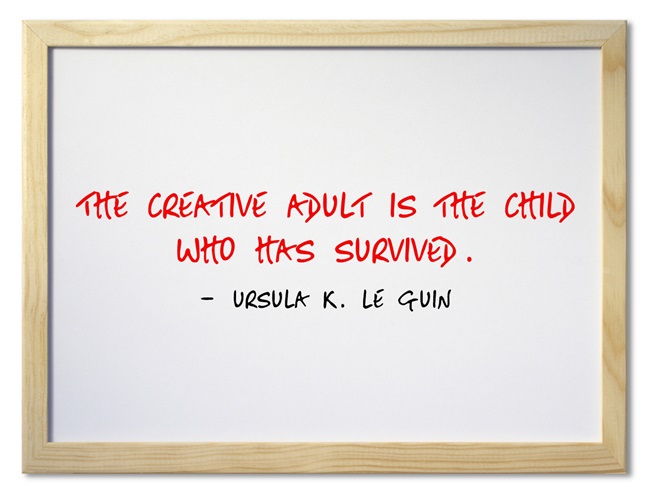
Hold On to Your Inner Child
Tagged with: creative adults, creativity, creativity quotes, journeys, the inner child, Ursula K. Le Guin
Posted in Quotes
Posted in Quotes
Handling Writing Rejection
 Freelance writer and storyteller Peter D. Mallett recently stated that everyone identifies with three things: failure, hard times, and rejection. The response to his post “Receiving and Rising above Rejection” was greater than any article he’s written for his website Writing in Color and demonstrates how deeply we all identify with being rejected. For a two-part followup to that post, Peter asked four writers, including myself, specific questions about the topic as it pertains to our writing projects.
In part one of “Rejection Revisited,” Erica Hayes, a copywriter, and Deanne Schultz, a freelance writer, were asked how they push through the fear of rejection and how they handle rejection when it does come. Their wise and practical advice shows why they’re successful professionals in their field.
In part two, Jillian Lisa Pearl, a writer working on her debut novel, addresses the issue of depersonalizing rejection and her positive plan to deal with it. For my part, I was asked: Even today, what is your first gut reaction when you receive a rejection? What happens next, and how do you move forward? My response to handling rejection almost always involves copious amounts of Cheetos, peanuts, and ice cream.
To find out more about how the four of us deal with rejection in our writing life, please check out Writing in Color and Peter D. Mallett’s articles on the subject.
How do you handle rejection or the fear of it?
————————
Image “Rejected Stamp” courtesy of cooldesign / FreeDigitalPhotos.net
Tagged with: Deanne Schultz, Erica Hayes, fear of rejection, freelance writer, handling rejection, Jillian Lisa Pearl, KL Wagoner, Peter D. Mallett, writing advice
Posted in My Guest Posts, Writing Advice
Posted in My Guest Posts, Writing Advice


 KL Wagoner