
History is the present. That’s why every generation writes it anew. But what most people think of as history is its end product, myth.
~ E.L. Doctorow
History is the present. That’s why every generation writes it anew. But what most people think of as history is its end product, myth.
~ E.L. Doctorow
 2015 will mark the 17th year thousands of writers from around the world begin National Novel Writing Month (NaNoWriMo) on November 1st. Few would argue this is a crazy journey—attempting to write a 50K-word draft of a novel in thirty days. Some might say it’s an impossible feat, but in 2014 over 58,000 participants completed their novel drafts (out of the 325,000+ who signed up). Most of those who didn’t “win” still made progress, still wrote more words than if they hadn’t stepped onto that road to give it a try.
Whether you’re planning to participate in NaNoWriMo or committing to your own writing schedule, finding the time to meet your daily word count is essential to success. For NaNo, that means writing 1667 words every day (or however you want to break it down). Here are a few things I’ve done to make the time to write and cross the NaNo finish line three years in a row.
1. Make friends with your calendar
♦ Mark off whole days or partial days in November that you know you absolutely won’t be able to write (like birthdays or Thanksgiving).
♦ Block off daily/weekly time for writing—before/after work or school, during commute time, lunch hours, your child’s naps. Get up earlier or go to bed later than usual. Even finding 15 minutes here and there will add up.
♦ Plan catch-up or get-ahead days. Make up for the days you know you can’t write and build in time for unexpected, but inevitable, glitches in your perfect plan. Weekly writing marathons can push you ahead after a setback. Local NaNo chapters often schedule write-ins.
♦ Reschedule and/or avoid setting appointments that can wait until a more convenient time.
2. Plan meals for the month
♦ Make slow-cooker meals, sandwiches, breakfast-for-dinner. Pick one night a week (or more) for fast food.
♦ Don’t forget Thanksgiving or other celebrations. Delegate to family/friends, if possible.
♦ Cook extra servings in October and freeze for November meals.
♦ Stock up on favorite snacks (for NaNoWriMo, popcorn and your favorite caffeinated beverage is considered a meal).
3. Get your writing space ready
♦ If you’re writing at home, de-clutter your writing space and prep for battle victory. Remove distractions, except for favorite writing quotes tacked to the wall.
♦ If you can’t write at home, scope out one or more places that will work for you. Local libraries are great if you like quiet or a coffee shop if you don’t mind the noise. I used to write in my car on my lunch hour.
4. Enlist help
Letting family and friends know how important this commitment is to you should elicit help with daily/weekly chores, like laundry and dishes, and vital responsibilities such as childcare.
5. Restrict television viewing and social media
Reward yourself with these when you meet your word count. Record your favorite shows to view later or build in time on your calendar.
6. Restrict socializing
Again, reward yourself after meeting word counts or build in this time. Or just say “no” and schedule a post-NaNo celebration with friends/family to make up for your transgressions.
7. Prioritize
Plan to do those things that are necessary and let the rest slide. This can be a difficult thing to do, especially if you’re a perfectionist, but doing so will make a huge difference in how much time you have to write.
8. Embrace your OCD tendencies
Be relentless in pursuit of the time to write those 1667 words per day.
If finding the time to write has been a stumbling block in the past, being fanatical for 30 days can get you into a routine and make a difference in your writing career. At the end of the month you’ll know how important your writing is to you, how committed you are to it, and what you’re willing to do to succeed. And if you keep on track, you’ll have a rough draft of a 50K-word novel as a result of your sacrifice and hard work.
Need more convincing? Check this list of WriMos who have gone on to publish their NaNo manuscripts including Jason M. Hough (The Darwin Elevator), Hugh Howey (Wool), and Sara Gruen (Water for Elephants). Read about the history of National Novel Writing Month and sign up to take the journey that begins November 1st.
Are you participating in NaNoWriMo this year? What’s your favorite trick for finding time to write?
Publishers want to take chances on books that will draw a clamor and some legitimate publicity. They want to publish controversial books. That their reasons are mercenary and yours may be lofty should not deter you. ~ Harlan Ellison
Don’t tell me the sky’s the limit when there are footprints on the moon. ~ Brad Foster (from a pen and ink drawing, 2012)
My first Worldcon [sigh].
 For years I dreamed of attending the largest convention gathering of speculative fiction fans held annually in different cities around the world. I couldn’t swing the time or expense when Worldcon came to San Antonio, Texas in 2013 (LoneStarCon 3) or London, England in 2014 (Loncon 3). When I heard the 2015 convention would return to the U.S. in Spokane, Washington (Sasquan), I decided this would be the year.
I knew it would be somewhat of a lonely drive for the 3000+ mile solo round trip, four days north and east from New Mexico to Spokane and three days back. But the two-week adventure also included visits with family members in three cities along the route.
What I didn’t expect were the overwhelming choices once I got to the convention and the mad scurrying to and from meeting rooms. I stayed up late each night trying to decide which panel or workshop to attend the next day. But the madness was my own fault—since this was my first (and maybe last) Worldcon, I didn’t want to miss out.
On Thursday alone, the first full day of the convention, the program listed over 175 events between 1:00 am and 10:30 pm. It would have been fun to watch some anime, a fan film or two, or to make a pair of fairy wings. But, doggone it, I wasn’t attending Sasquan to have fun. I was there to glean knowledge about writing and publishing from the experts. I passed up discussions about Discworld, steampunk, and the Klingon language for talks I thought would serve me better on my writing journey. I made some hard choices, such as sitting in on workshops about worldbuilding, ambushes and counter-ambushes, and how to develop a realistic economy, instead of learning about the future of government, the future of military SF, and medieval science and engineering. That was just the first day.
On other days I learned about the effects of low gravity on the human body, how the experts edit anthologies, and the future of short fiction (from the editors of Beneath Ceaseless Skies, Clarkesworld, Strange Horizons, Galaxies Edge, and Lightspeed/Nightmare magazines). I took pages of notes on two of my favorite workshops that dealt with how to build an empire (double workshop) and the craft of short fiction, both of which I’ll cover in future blog posts.
But my convention experience wasn’t all a frenzy of learning. I allowed myself a Stroll with the Stars along Spokane’s Centennial Trail behind the convention center, a reading with one of my favorite authors, and the experience of a lifetime at the Hugo Awards. Here are a few more highlights:
John Scalzi:
Mr. Scalzi read from two of his manuscripts (one a work in progress), then entertained the audience with a song on an attendee’s ukulele and a fun question and answer period. At one point, he referred to his list of twelve “Standard Responses to Online Stupidity” posted as a resource on his website. Everyone who surfs the internet has probably read this list, but it was new to me. He compiled it because “from time to time, in your ordinary exercise of the delights of the online world, you may find yourself accosted by clods.” The list begins with, “I don’t care what you think” and ends with “My attention is a privilege, not a right. This is all you get.” I like #4: “You’ve attempted logic. Not all attempts succeed.” But according to Mr. Scalzi, his favorite is #8: “It appears an ***hole has hacked your account and is posting in your name.”
Brad Foster:
I took home two small pieces of artwork by Brad Foster who was one of the convention’s guests of honor. Copyright prevents me from posting my favorite of the two—an original 6×8, black and white pen & ink drawing of a cute alien looking up at a crescent moon. The quote penned as part of the artwork is great: Don’t tell me the sky’s the limit when there are footprints on the moon. (After Worldcon 2015 ended, I learned that Mr. Foster draws robot portraits, caricatures he calls “inner robots,” for a reasonable price at the conventions he attends. He also takes orders anytime through his website.)
 Hugo Awards:
Despite the controversy surrounding the voting process for the Hugo Awards, hosts David Gerrold and Tananarive Due did an awesome job of keeping the audience entertained. I went to the ceremony expecting to be bored at some point but ended up enjoying the entire three hours. Lots of laughter, some tension due to the possibility of No Awards in many of the categories, and a touching moment when Mr. Gerrold was overcome with emotion at the number of his friends on the in memoriam roll. A list of winners is available at the Hugo Awards website, as well as statistics that include the No Awards. And if you weren’t as lucky as I was to be in the audience, you can watch a replay of the ceremony on Livestream.com.
One final takeaway: If I decide to attend another Worldcon, I will (a) take a plane or share the drive, and (b) make sure to have some fun.
Have you attended a Worldcon? What was your favorite part of the experience?
“Worldcon,” “Hugo Award,” and The Hugo Award Logo are service marks of the World Science Fiction Society, an unincorporated literary society.
Joyce Hertzoff retired from a profession grounded in fact and science and now uses the power of the pen to write mystery and fantasy stories. Her first novel The Crimson Orb was published in 2014 by Phantasm Books, an imprint of Assent Publishing. Under Two Moons, her second in the series, is forthcoming. Read a complete list of Joyce’s published works on her SWW Author Page. You can also find her on Facebook and Twitter, and visit her at FantasyByJoyceHertzoff.com and HertzoffJo.blogspot.com.
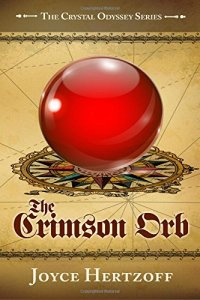 What was the spark that led you to write your first fantasy novel The Crimson Orb?
I love to read fantasy stories, but I had never written one until I decided to give it a try for National Novel Writing Month (NaNoWriMo) in 2008. My third NaNoWriMo (2010) produced the draft for The Crimson Orb. I’ve participated nearly every year since then, even doing two NaNo Camps. Each time produced a 50 K draft of a story or the second half of one: two romantic mysteries and the rest fantasies. I’m hoping to do it again in November to get started with book four of the Crystal Odyssey series.
You’re in the process of completing the third book in the series. What is the most challenging aspect to this multi-book project?
Each book has tons of characters. I need to keep a notebook so I can be consistent when I write about any of them. Nissa, the main protagonist in the series, meets many people during her travels and, as much as I love to develop each of them, coming up with names and remembering them all can be challenging.
If you had an unlimited budget, how would you spend your money for marketing and promoting your books?
There are paid services for publicizing books, but I’m not certain they are worth the money. I’d love to do a video trailer for The Crimson Orb.
Do you have a message or a theme that recurs in your writing?
Totally. It’s a combination of: 1) females can do anything and should be given opportunities they sometimes aren’t; and 2) every lesson and experience is important in the growth of a person.
What are your strengths as a writer, and what do you do to overcome your weaknesses?
I’ve been told I write very natural, believable dialogue, but also that I sometimes fail to describe both characters and settings. When I edit, I always add more descriptions. The trick for me is adding them without taking a reader out of the story.
You spent over four decades in the scientific information business. How did your experience writing nonfiction impact your fiction writing?
I’m naturally left brained and also compulsive. Combined with my previous experiences, I’m almost driven to make sure my stories make sense, that the science is at least possible, and that the details of the worlds I create remain constant. But years spent writing stark just-the-facts abstracts of scientific papers probably contributes to my problems with providing descriptions and extraneous information.
You’ve been active in the fan fiction community for several years. How did fan fiction impact your journey to publication?
Writing fan fiction (which I still do) gave me lots of practice in developing convoluted plots and complicated characters, since I always build on the canon characters of each fandom by adding OCs (characters outside the canon). It also gave me the confidence to attempt to write original stories. I agree with all of the pundits who say the best way to develop writing skill is to write, write, write. I guess it doesn’t matter what. [Her fanfic on fanfiction.net and Archives of Our Own are under the name hilandmum.]
Who are your favorite authors? Who do you wish you were more like in your own writing?
My reading tastes are eclectic. Too many authors to list. I don’t particularly want to write like some of the more successful writers, though.
How do you break through writer’s block?
I don’t tend to get writer’s block, although if I do, I’m usually working on so many projects, I can always switch my attention to one of the others. I do sometimes write myself into a corner; when I do I let the piece sit, and at the strangest times, a way out occurs to me.
What projects are you working on now?
I’m working on the third book in the Crystal Odyssey series (working title Journey to Fartek), as well as another fantasy series, a couple of murder mysteries, and a post-apocalyptic story. My head is full of ideas for more, too.
For Part 1 of this interview, published on the SouthWest Writers website, click here.
Our strongest defenses are built around our greatest weaknesses. As a writer, you will only get better by addressing the weakest parts of your writing. We all tend to want to focus on our strengths, but a book is only as good as the weakest part. ~ Bob Mayer
I hope you find something useful, or amusing, in this next batch from my bottomless bag of (lost and) found online articles and tidbits.
■ For Writers:
 Create an Author Business Plan
As part of the Indie Author Series on Janice Hardy’s Fiction University website, Marcy Kennedy has written “Create an Author Business Plan” that breaks down this task into manageable pieces. After an introductory post that gives three questions to ask yourself before writing a business plan, she continues with an article about setting your author goals that “might be the most important of your whole business plan because the rest of the plan is basically about taking these goals and creating actionable steps to reach them.” Other articles in the series: choosing our stories, identifying our audience, running our business, crafting our product plan, analyzing our competition, developing our overall marketing plan, and book by book marketing.
Copyright Inheritance
Read Susan Spann’s article “Who Inherits Your Copyrights?” to find out the importance of having an estate plan that includes specific references to administration of your copyrighted works.
The Problem with Clichés
If you’ve ever wondered why authors are advised to avoid clichés in their writing, watch the video “Is that what I think it is?” for a demonstration of how quickly an overused phrase becomes annoying.
■ Science:
Predictions Come True
Check out io9’s article “The Most Futuristic Predictions That Came True in 2014” featuring 15 “incredible technological, scientific, and social achievements, from mind-to-mind communication to self-guiding sniper bullets.”
■ Fantasy:
 Mythology and Magical Creatures
Mythic Scribes runs a series on their website called “Magical Creatures for Magical Worlds” written by Alice Leiper. So far the series has covered the Hydra, the Phoenix, the Minotaur, and Fairies.
■ For Fun:
Sad Cat Diary
When I first watched this video several years ago, I laugh-cried uncontrollably. It’s not a cute-and-cuddly animal video so even if you don’t love cats, it just might make your day.
■ Yep, Yummy:
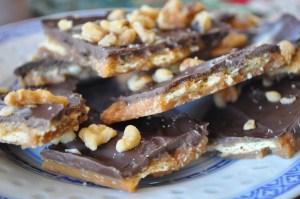 Fool’s Toffee
I sampled this dessert at a recent album-making event and couldn’t stop myself from returning to the snack table over and over and over. It’s a simple recipe—no candy thermometer involved—made with brown sugar, butter, chocolate chips, nuts, and saltines. Yes, saltine crackers. Don’t balk, just give it a try. You will not regret it.
Image “Notebook With Pen” by Piotr Wojtkowski from PublicDomainPictures.net
Don’t wait for others to inspire you. Don’t wait for inspiration at all…there’s no better reason to tell your story than a simple love of words. ~ Cara Lopez Lee
Speculative fiction (science fiction, fantasy, horror, magic realism, and slipstream) gives voice to those who explore societal and technological change along with deeper considerations of underlying archetypes of human experience.
~ from the Clarion West site
 Speculative fiction? What’s wrong with the terms science fiction and fantasy? (And get off my lawn!)
Nothing’s wrong.
But as human imagination pokes into new corners, makes mashups of old categories and roams around the zeitgeist in ways that would have alarmed our literary forbears, fiction has ranged so widely that an umbrella term has emerged for this adventuring.
Speculative fiction: it’s not just magic and little green men.
What is it, then?
For one thing, it’s a helluva lot of fun. To mess around with magic (i.e., make human yearning visible), design cultures and tinker up universes—what’s not to like? Some dismiss it as pretty low-class fun: beach reading, wish-fulfillment, green slime and improbable sex (again, what’s not to like?). But in variety, depth and class this immense genre has evolved dramatically since the days of Conan and tin rocket ships. Speculative fiction is what happens when you put no limits on the question, What if?
And answers to that “What if?” can be profound. Even in its snotty adolescence, speculative fiction was a thinking tool, a literature of ideas. It’s sometimes not appreciated how expansive, and how deep, that thinking can be.
What we call “science” fiction has always functioned as a creative playground for technology. What’s less realized is spec fic’s potential for exploration in the humanities. When applied to human culture and feeling, fictional play is an experiment in understanding—one that works, not by data, but by image and story.
Why do we need this passionate play? Especially now?
We are thrown together in a shrinking and interconnected world. We need ways to think about ourselves and our neighbors, because—consciously or otherwise—we project our stereotypes on one another.
It’s embarrassing. Plenty of my own North European relatives (who have been here four hundred years, long enough to get a clue) still subconsciously believe that those of you who are Native American spend most of your time wearing feathers and thinking deeply spiritual thoughts. And that you who are Hispanic are sub-literate and tend to be found asleep under a species of cactus that doesn’t even grow in New Mexico.
This cuts both ways, of course. I teach at Zuni Pueblo, where a small girl once said to me, “When I was little, we used to play White People.” I said, “Um…how do you play that?” She said, “Oh, you know. You get two chairs, you put a sheet over them and sit in there. Then your friend comes and says, ‘Good afternoon! How are you?’ And you say, ‘I’m very well, thank you. Would you care to come in?’ And she says, ‘Why, thank you ever so much. I don’t mind if I do.’” (The White People in question must not have been from Albuquerque, where we shove the dog off the couch and say, “Yo!”)
The uneasy truth is that as we try to figure one another out we invariably end up writing, not about the Other, but about some projection of ourselves. Yet we’re all human and we’re all here: we have to gossip about our grand exchange.
I dare you to claim fiction isn’t gossip.
In our global cultural dilemma, enter speculative fiction with its wild subgenres, loaded for bear and no holds barred. Got dangerous questions of human nature, prejudice and power? Give them an imaginary setting. An invented universe won’t distort and defame a living culture, yet has room for experimental thought and human drama. Need a lab where you can build experimental worlds, examine stereotypes and racial injustice and let them play out to logical conclusions? The key is in your hand.
The worlds you invoke may be variations on this one that mess with a few basic laws of physics, or they may be made-from-scratch worlds. Think Joy of Cooking, not microwaveable Lean Cuisine.
Even when it’s disguised as weekend reading, spec fic can provide an experimental forum. In it we can wonder, speak our longing, express love and rage and grief. We can tackle conundrums of science and the heart and blending cultures, without the exploitation or misrepresentation that can be a danger in more literal fiction.
What’s more, just as you can’t build a livable house without a deep knowledge of how houses are put together, you can’t build a viable imaginary world without being forced to examine, deeply, how worlds and cultures work. Including your own.
So shove that dog off the couch, pull up the laptop and build a new world. Speculate.
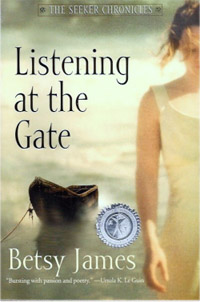 Betsy James is the author-illustrator of sixteen books and many stories for adults, teens, and children. Her latest novel, Listening at the Gate, is a Tiptree Award Honor Book and a New York Times Best Book for the Teen Age. Forthcoming: Roadsouls, her next fantasy, will be available in 2016 from Aqueduct Press. Visit her at BetsyJames.com and ListeningAtTheGate.com.
This article was originally published in the September 2013 issue of SouthWest Sage and is reprinted here with permission of the author.
The world is made of stories, not of atoms. ~ Muriel Rukeyser


 KL Wagoner