Last Friday Finds: Coolness from the Web

I’ve amassed a ridiculous number of online articles and tidbits on every sort of topic, from a single post on how to make a fairy garden to thousands of postings about how to write a novel. There are so many, I know I can’t possibly read them all (kind of like the scary number of books on my Kindle). Yet I keep saving them away, many in a file labeled “later.” I wanted to start sharing a few of the articles I’ve actually read (and some videos I’ve watched) on the last Friday of every month. Here is the first batch for your perusal. Enjoy.

■ For Writers:

Flog a Pro

If you haven’t discovered the “Flog a Pro” series by Ray Rhamey on Writer Unboxed, you might want to check it out. Mr. Rhamey submits the first 17 lines from a bestselling book and asks, “Does this narrative compel you to turn the page?” He then explains the reasons for his yes or no vote. Seventeen lines doesn’t seem like enough to pique a reader’s interest but “editors and agents often make their read/not-read decision on the first page. In a customarily formatted book manuscript with chapters starting about 1/3 of the way down the page (double-spaced, 1-inch margins, 12-point type), there are 16 or 17 lines on the first page.” The posts include a first-page checklist which is a helpful reference for writers trying to improve their work and their chances of creating a page turner.

Taking (or Leaving) Writing Advice
In “Writers: Ignore This Writing Advice. If You Want,” author Janice Hardy from the website Fiction University advocates “understanding what we [writers] do and why we do it. The more we know about our process and what we’re trying to achieve, the easier it is to spot ‘good, but not good for us’ advice…. If that [process] works for you, it works. If you’re happy with the results you get, there’s no need to change it. If you’re not happy, then it’s up to you to decide what to change to achieve the results you want.” She also says, “If you find yourself frequently saying, ‘yeah, but…’ every time you hear/read/see advice, that could indicate a reluctance to grow as a writer…you might want to take a step back and think about why you’re fighting it so hard–especially if you’ve been receiving the same advice from multiple sources (as in a critique).”

Scifaiku Poetry
Do you write science fiction and poetry? You might want to try scifaiku—similar to haiku, but “it contains the use of technology, human insight, and vision of the future that is natural in science fiction stories.” I had never heard of this form of poetry until I came across the article “A Primer for Writing Scifaiku Poetry” by Wendy Van Camp.

Science:

Why I Had to Invent a Star Drive

Rocket200Author Graham Storrs discusses rockets, warping space, quantum theory, and made-up physics because sci-fi writers “have stories to tell that won’t wait decades or centuries while all those geniuses [scientists] clamber slowly up onto the shoulders of giants. If you want to go faster than 10c, you’ve just got to make stuff up—but plausible-sounding stuff, not just any old stuff, or you might as well be writing fantasy.”

Top 10 New Species of 2015
IFL Science shares the list of top ten new species selected by the ESF International Institute for Species Exploration from over 18,000 species discovered during the last year.

For Fun:

Apache vs. Dragon: Who Would Win?
Watch as a dragon takes on a AH-64 Apache helicopter.

Dancing Baby Groot
Follow the do-it-yourself steps artist Darren Carnall took to create a dancing baby Groot (from the movie Guardians of the Galaxy) as a birthday gift for his wife. And then watch the video of the final result. FYI: the video may not work on mobile devices.

Ostrich Pillow

OstrichPillow200When I first saw the photo of this product, I laughed so hard I cried. I kept imagining walking down the hall at my old workplace and seeing a colleague in this position. Who would really stick their head in a pillow and sleep on their desk, at work? Maybe a man…but I don’t think a woman would chance mussing her hair. Click on the photo if you’re interested in finding out more (I am not an affiliate).

Yep, Yummy:

Cream Biscuits (Only 2 Ingredients)
The (copyrighted) photo of these biscuits was enough to make me stop everything and do some research. The two ingredients? Self-rising flour and cream, plus melted butter for the top. You’ll find some great advice on how to make biscuits, such as “do not twist your biscuit cutter” when pressing into the dough (this seals the edges and stops the biscuits from rising). I resolve to make this recipe, y’all, before the summer is out.

5 Ingredient Peanut Butter Chocolate Chip Cookies (Gluten Free, Dairy Free)

5IngredPBChocChipCookies200This has become my favorite cookie recipe—not only for the taste but the soft texture and the simplicity of putting it together. I make these several times a month for family and to share at SouthWest Writers meetings. Just mix the five ingredients together by hand, roll into balls (I flatten them a bit before baking), and pop them in the oven for nine minutes. Try the recipe and let me know what you think.


Image “Rocket” courtesy of renjith krishnan at FreeDigitalPhotos.net

Tagged with: , , , , , , , , , , , , , ,
Posted in Just Because, Last Friday Finds

Surrendering to the Magic

magicstorytelling9

I’ve found that the magic of storytelling is in surrendering, not to anyone else’s notions, but to the words in my head. I believe this: my subconscious knows better than I how to tell a story… Sometimes the best writing strategy is no strategy at all, simply the willingness to let the subconscious take over. ~ Cara Lopez Lee

Tagged with: , , , , ,
Posted in Quotes

Taking on the 777 Writing Challenge

SkeletonsPartsOnTheFloorI first noticed the 777 Challenge several months ago on Joyce Hertzoff’s Facebook page. It seemed a great way to share a bit of a writer’s work-in-progress. I’d been wondering how one gets picked for such a nifty challenge—and considered starting one of my own—when my turn came around…

D. Wallace Peach tagged me last week to join in the fun. She’s the author of five fantasy novels, and she blogs at Myths of the Mirror where she encourages writers of all genres. Her newest book, The Sorcerer’s Garden, is scheduled for release on August 20.

To participate in the 777 Writing Challenge, writers go to page 7 of their work-in-progress, count down 7 lines, and then share the next 7 sentences in a blog post. Finally, participants tag 7 other writers to share excerpts from their own WIPs.

For my contribution, I’m sharing seven lines from the forever-draft of my current dark fantasy novel The Last Bonekeeper written from the point of view of the novel’s main character (who isn’t named in this excerpt). We drop into the scene with the bonekeeper’s men refilling a grave after harvesting the bones, and anticipating an encounter with a pack of devil dogs:

“Luck ’o the bones, luck ’o the bones,” Crust prayed over and over, faster and faster, as he bent to fill the grave.

There were enough of them now to finish the task, if time was on their side and the dawn rose quick. Enough of them to stave off an attack, if most of the devil dogs kept busy with the remains of their prey. If luck held out. Always too many ifs.

“They’re coming.” Dred stepped away from the hole, his pike spinning faster.

I’d like to pass the challenge to the following writers. Participate if you can, but no worries if you can’t.

Allison D. Reid at The Weaving Word
Renee Scattergood at Renee Writes
Louise Findlay at Louise Findlay Books
L. Palmer at The L. Palmer Chronicles
KJ Hawkins
Nichole Giles
Melissa Barker-Simpson

I look forward to reading your excerpts!

Readers, if you’ve already participated in the 777 Writing Challenge, please leave a link to that blog post in the comments, or if you just want to share, post seven lines from a work-in-progress and a link to your website.


Image “Skeleton Parts On The Floor” courtesy of David Castillo Dominici at FreeDigitalPhotos.net.

Tagged with: , , , , , , ,
Posted in Sharing My Writing

We Write Our Own Truth

BillKenowerQuote4

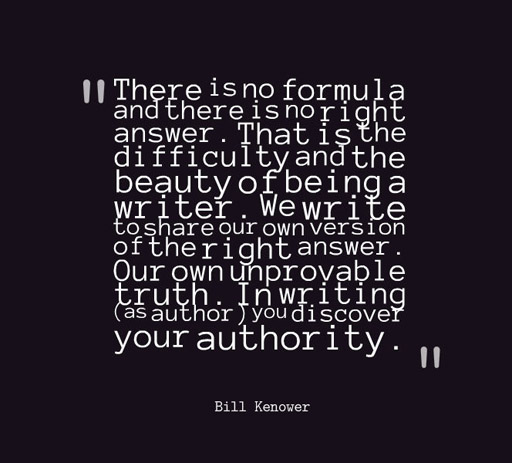
There is no formula and there is no right answer. That is the difficulty and the beauty of being a writer. We write to share our own version of the right answer. Our own unprovable truth. In writing (as author) you discover your authority. ~ Bill Kenower

Tagged with: , , , , ,
Posted in Quotes

The Book That Sparked My Love of Science Fiction

Ed White, Gemini 4, Over New Mexico (NASA photo ID S65-30433)

Ed White, Gemini 4, Over New Mexico
(NASA photo ID S65-30433)

20,000 Leagues Under the Sea by Jules Verne? The Time Machine by H.G. Wells? Brave New World by Aldous Huxley? All great books, but none of these classics was the first to take me away to another world.

By 1967, the Gemini space program had made walking in space a “common” occurrence. I was 10 years old, the youngest in my sixth grade class, and one of the few who wore glasses. My dream of blasting into space had been ripped to shreds the year before after discovering NASA only accepted astronauts with perfect vision. The television shows Lost in Space and Star Trek put a Band-aid on my broken heart and satisfied some of my need to explore the universe. But there was still something missing.

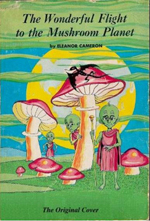
I was a reader. I had gone through most of the books in my parents’ house—all good stories, but every one grounded on the Earth. Science fiction in written form didn’t exist in my life until a teacher read aloud The Wonderful Flight to the Mushroom Planet by Eleanor Cameron. As the story unfolded thirty minutes at a time over the course of many weeks, the real world fell away under the beckoning power of a newly discovered land.

WonderfulFlightToTheMushroomPlanet_150The adventure began on the first page with a newspaper ad printed in green:

Wanted: A small space ship about eight feet long, built by a boy, or by two boys, between the ages of eight and eleven. The ship should be sturdy and well made, and should be of materials found at hand. Nothing need be bought. No adult should be consulted as to its plan or method of construction. An adventure and a chance to do a good deed await the boys who build the best space ship. Please bring your ship as soon as possible to Mr. Tyco M. Bass, 5 Thallo Street, Pacific Grove, California.

The story continued with the two protagonists building a spaceship out of spare parts, flying to the planet Basidium and attempting to rescue its inhabitants from a terrible sickness. Mushroom Planet had it all. Aliens. Science meshed with fiction. A mysterious inventor. And a chicken that saved the day. I couldn’t wait to find out how the story ended. At the same time, I didn’t want the story to end at all. It was the first of countless love affairs.

The Wonderful Flight to the Mushroom Planet was my introduction to science fiction and the one that lit a spark that never died. I went on to discover the works of Ray Bradbury, Arthur C. Clarke, Pohl Anderson, Clifford Simak, Brian W. Aldiss, Andre Norton, and many more (including the classics by Verne, Wells, and Huxley).

I’ve never gotten over the thrill of discovering a new world. After all these years, I suppose I’m still trying to fill the void of a broken dream and find a way to take my own spacewalks.

What was the first book that started a love of reading in your favorite genre?

Tagged with: , , , , ,
Posted in Musings, The Writing Life

Save Your World: Keep Reading

Ray Bradbury Quote_5

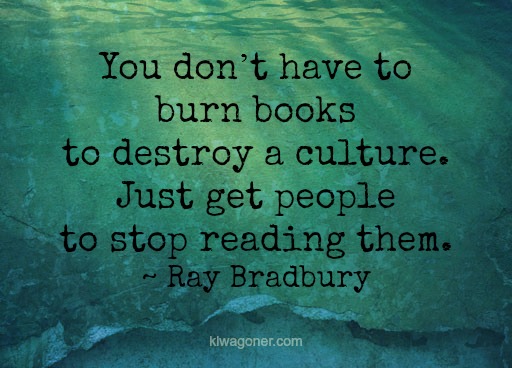
You don’t have to burn books to destroy a culture. Just get people to stop reading them. ~ Ray Bradbury

Tagged with: , , , , ,
Posted in Quotes

A Word with Diana Gabaldon and George R. R. Martin

In May 2014, Albuquerque Public Library Foundation and Bookworks, a local independent bookstore, launched the author series “A Word with Writers” beginning with George R. R. Martin and Diana Gabaldon. Author Lorena Hughes attended the event at the KiMo Theater. Her subsequent article was originally published on The Writing Sisterhood blog, and is reprinted here with Ms. Hughes’ permission.


A Word with Diana Gabaldon and George R. R. Martin
by Lorena Hughes

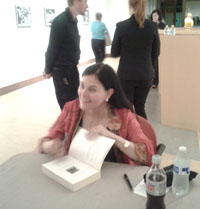
GabaldonMartin300Last weekend, my writing sisters and I attended a fun event sponsored by our city library and a local bookstore. A Word with Writers consists of a candid conversation between two acclaimed authors who share experiences and anecdotes about their writing. The inaugural lecture featured none other than the beloved Diana Gabaldon, the author of the Outlander series, and George R. R. Martin, the brains behind the successful Game of Thrones. They both had a lot to say about what inspired their work and what their writing processes are like. Here are some of the evening’s highlights.

About their backgrounds and what inspired their books:

Gabaldon’s background is very interesting because she’s a scientist with degrees in zoology, marine biology and ecology. She blames her father for this copious amount of studying since when she was young, he had told her that she was a “poor judge of character” and would probably marry badly. To avoid a life of poverty, he recommended that she became a self-reliant professional. Gabaldon obediently got her PhD.

In her mid-thirties, Gabaldon decided to write a novel, more as practice than anything (she didn’t intend for anyone to read her work). Since she was so good at doing research and she liked history, she decided it would be a historical novel. Now the only question was where/when should she set it? The answer came to her while she was watching an episode of Dr. Who and spotted a man in a kilt. She was so taken by this man that she decided to write about a Scotsman. Being that a novel requires conflict (to her own admission, this was all she knew about novel-writing) she settled on the Scottish wars against England during the 1700s. Of course, she needed a woman to create some sexual tension with this beautiful man. Claire came to Gabaldon through an image of a woman in a cave full of men. She was English and very different from other 18th century women. When Claire opened her mouth, she recited her full name. There was nothing Gabaldon could do to tame her modern spirit. She fought with her throughout the novel, but eventually gave up and told her: “Go ahead and be modern, I’ll figure out why later.” In that sense, she confesses, the time-traveling element in Outlander was an accident.

In contrast, Ser George had always been a writer and a reader. He was a Sci Fi, Fantasy and Horror fan–which used to be the same genre–and as a child, he wrote and sold horror stories to other kids. He eventually earned a master’s degree in journalism. For many years, he worked in Hollywood as a TV writer in shows such as The Twilight Zone and The Beauty and the Beast, but there came a time where he wanted to work on his own stories, and so he turned to novel writing. When asked about his inspiration, he mentioned Tolkien as a big influence.

About their writing processes:

GeorgeRR_Martin200Martin offered an interesting analogy for writers. He said there are two kinds of novelists: gardeners and architects. An architect designs a blueprint, plans how he’s going to develop it and then does it. A gardener digs a hole in the ground, throws seeds and water, and hopes something will grow. Martin admits he’s a gardener. When he started A Song of Ice and Fire, he didn’t have a clear idea of where he was going with the story. All he had was the first scene and characters who kept telling him what they wanted. But characters can be treacherous, he says, and like a gardener he sometimes has to pull out weeds–which might explain why he kills so many of them!

Following the same analogy, Gabaldon also calls herself a gardener. However, her process is not linear, like Martin’s, but “organic.” She gets an image in her head and fleshes it out into a scene. Once she has several chunks, or scenes, she stitches them together into a narrative. She admits that when she started she didn’t know anything about writing novels (she had, however, written a 400-page dissertation). So she set two rules for herself: a) she wouldn’t stop, no matter what, and b) she would do the best she could.

Before she was done with the first Outlander book, she found an agent who was so taken with her story he signed her on right away and sold her book in four days. She didn’t originally plan to write so many sequels, she just knew that “there was more.” Her agent originally got her a three-book deal, but the novels kept coming. Her writing is so accidental that her next series following the adventures of Lord John, a secondary character in the Outlander series, came about because she was invited to participate in an anthology of short stories. Since she didn’t want to interfere with Outlander’s main characters and plot, she thought of Lord John–who then took on a life of his own.

Martin agreed with Gabaldon in that he didn’t plan to write such a long series either, but he was happy to do it since readers nowadays love to follow characters for 10-15 years. He says his entire series is one continuous story told in several books.

About their use of language:

Since Martin’s novels are set in a “quasi medieval world” he had to find a balance between modern syntax (so the audience wouldn’t be lost) and flavoring his text with archaic words to give the novel a proper context and avoid anachronisms. He called this the “common tongue of all fantasy novels.” He initially overused words like “mayhaps” or “forsooth,” but his editor objected. They reached a compromise by having the older characters use these terms and the younger ones employing a more modern language–as it tends to happen in real life.

Martin did not invent languages the way Tolkien did (he joked that Tolkien wrote The Lord of the Rings just so he could use his languages) but he made up five words of High Valyrian, and will make up a 6th if necessary. For the show, however, whole languages had to be invented since you can’t just say, “She said in High Valyrian.” Now when he writes a scene, he has to call HBO to ask how a character might say something in whatever language. The show hires people whose hobby is to invent languages with proper syntax and grammar to develop Dothraki and High Valyrian. As a funny anecdote, Martin mentioned that a fan once requested a High Valyrian dictionary.

Gabaldon mentioned that she has a few translators who help her with Gaelic, and she loves the sound of it.

About their TV shows:

Diana_Gabaldon200Gabaldon announced that the Outlander series is now in production. The producer, who had previously worked in Battlestar Galactica, took two days to talk to her about the show. They decided that as a prologue, they would show a scene of Claire in a military hospital during WWII. Gabaldon had a blast inside the “Outlander world.” She admitted that at first she didn’t like the actor [Sam Heughan] selected to play Jamie Fraser, but after seeing his audition she knew he would be absolutely perfect for the role (even though he accidentally said “OK” during a scene where Jamie was being pressured to marry Claire).

It took a lot longer to find Claire and poor Sam had to go through innumerable “chemistry tests.” Eventually, they found an actress who had the right chemistry with Sam and would play the perfect Claire. When someone asked Gabaldon if she would like to write for TV, she confessed she’s not a team player and likes to keep control of her writing.

Martin, on the other hand, mentioned that he writes one script per season and would love to write more, but he has yet to finish two 1500-page books. Yeah, you read correctly.

What’s interesting is that both shows will share actors. Apparently the BBC has churned out twenty or so actors, who participate in everything involving an English or Scottish accent. Every single one of them is in Game of Thrones, and, according to Martin, will appear in the Outlander series after they are killed off from GOT. (Ha!)

Anecdotes and questions:

Martin was asked which part of Westeros he’d choose to live in, if he could. He said Dorn. “It’s warm, the women are warm, and the food is spicy. It’s New Mexico!”

Gabaldon mentioned that during an interview with a German reporter she tried to keep her tongue in check, she said she loved a man in a kilt because “you know he could have you up against a wall in 30 seconds.”

When asked about their thoughts on self-publishing, neither one of them recommended it. Martin said writers are supposed to write, not publish or market books. He commented how sad it was to see writers desperately trying to sell their work in Bubonicon conferences and such, and how people often avoid them. Martin thinks that self-publishing is only a good idea for well-known authors whose names alone sell books.

They both acknowledged that it’s not easy to break into publishing, but the only thing a writer can do is keep writing.

In spite of the fans who wanted hints about how both series will end, neither Gabaldon nor Martin said a word. The only thing Gabaldon admitted to was having written the last scene ten years ago. “How I will get there is an entirely different question,” she said.


LorenaHughes2Lorena Hughes was born and raised in Ecuador. At age eighteen, she moved to the US to go to college and got a degree in Fine Arts and Mass Communication & Journalism. She has worked in advertising, graphic design and illustration, but her biggest passion is storytelling. Her historical novel set in South America, The Black Letter, took first place in the 2011 Southwest Writers International Writing Contest (Historical Fiction category), an Honorable Mention at the 2012 Soul-Making Keats Literary Competition, and was a quarter-finalist at the 2014 Amazon Breakout Novel Award (ABNA). She is represented by Liza Fleissig of the Liza Royce Agency and is a freelance writer for What’s Up Weekly. You can find her on Twitter at twitter.com/SisterLorena.

Tagged with: , , , , ,
Posted in The Writing Life

Creativity’s Enemy

The-worst-enemy-to5

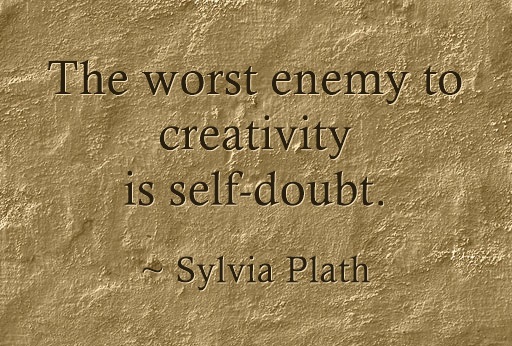
The worst enemy to creativity is self-doubt. ~ Sylvia Plath

Tagged with: , , ,
Posted in Quotes

The Benefits of a Genre-Specific Critique Group

3d Figure Playing Jigsaw PuzzleIf you’re blessed, as I am, to have some of the best critique partners…, you undoubtedly realize the benefit of having a watchful pair of eyes to run over your manuscripts, a merciless tongue to point out the weak points, and a gentle (and sometimes not-so-gentle) touch to encouragingly push you back onto your feet for another go. ~ K.M. Weiland

I currently participate in two critique circles. One is a mixed-genre group of writers of different skill levels ranging from beginner to advanced. Half the writers are traditionally published, one a bestselling author with one of the big houses. I am blessed, as K.M. Weiland says, to be a part of this diverse group. In just a few months of giving and receiving feedback, my writing improved more than it had in the previous year. It was not my fantastic critiquing skills (far from it) that won a spot for me in this group, but the recommendation of a fellow member of a now defunct critique circle. A good lesson in not burning bridges.

My other critique circle is genre-specific, specializing in science fiction and fantasy. Though we have different writing styles and target audiences, we all share: a similar skill level; a publishing path with small, traditional presses; and a love of speculative fiction. We often have long discussions about the writing life, marketing, and the finer points of such things as map making and world building.

Benefits of a (Good) Critique Group
From my experiences in a handful of critique groups (both good and not), I’ve found the typical benefits of being a member include:

  • receiving feedback that reveals the strengths in my writing, and weaknesses such as overused words, passive construction, and cliché characters
  • learning to take criticism with the right attitude
  • becoming a better self-editor (examining someone else’s writing helps me recognize the flaws in my own)
  • committing to have a submission ready on a regular basis keeps me motivated to write and edit
  • encouragement to continue writing and striving to improve (the right group will make you want to go home and get back at it)
  • learning better or different ways to deal with writing elements, such as characterization, setting, and dialogue

Benefits of a Genre-Specific Critique Group
It makes sense that someone who writes in a certain genre also reads in that genre. In my opinion this is the greatest benefit to joining a focused critique group. Writers should be readers, and readers make the best writers. I hope I always have a seat in the mixed-genre circle, but until I joined the speculative fiction group, I missed the camaraderie of a shared love of this genre. Other benefits include:

This group understands the genre, they will “get it” (or not) and give appropriate feedback:

  • Sci-fi and fantasy readers know the truth will be revealed in time. They are more willing than most types of readers to “wait for it” in a future or fantastical world. Terms such as FTL (faster than light) don’t need explanation, and magic systems (if done correctly) are readily accepted.
  • In a romance story, if there is no happily ever after or the couple doesn’t get together in some way at the end, beware the wrath of the romance reader.
  • A horror story should scare the reader, or at least induce goose bumps.
  • Historical fiction readers expect a time period to come alive (and they are likely to spot historical inaccuracies).
  • A mystery must provide a puzzle to be solved, with plenty of clues throughout the story for the hero and the reader to keep guessing “whodunit.”

This group recognizes over-used or already-used plots specific to a genre. Our world can never have enough zombie-eats-human stories, but it would be good to know if your human-eats-zombie tale is a fresh twist on an old favorite. Editors and publishers are constantly on the lookout for unique stories.

This group can be a great guide to finding a target audience. Knowing who your reader is will help market your work, as will pinning down a specific sub-genre: paranormal romance vs. romantic suspense, dystopian vs. apocalyptic, medical thriller vs. police procedural. (For a good listing of writing genres, see Janice Hardy’s article “Is It a Genre That Starts With F? Breaking Down Genres.”)

A writer’s skill can only be improved to a certain degree by taking courses and studying how-to-write books. Eventually, constructive feedback from other writers is a necessity. A mixed-genre critique group is a good choice when you’re ready to take the next step toward improving the quality of your writing. Seek out a genre-specific group to focus on your particular reader. And if you can fit both into your life, do it.

One last point: Besides improving your craft and satisfying a reader’s thirst for a good story, learning to be a better writer through participating in a critique group will save you money when it comes time to submit your work to an editor who charges by the hour (or the page) to fix your mistakes.

What part do you think a critique group plays in a writer’s journey?


If you’d like some pointers on starting your own critique circle, check out “Critique Circle Basics: Setting Up an Effective and Efficient Support Group” by K. Kitts.


Image “3d Figure Playing Jigsaw Puzzle” courtesy of renjith krishnan / FreeDigitalPhotos.net

Tagged with: , , , , , , , , , ,
Posted in Critiquing and Critique Groups

The Write Attitude: Ray Bradbury

DrunkOnWriting600

You must stay drunk on writing so reality cannot destroy you. ~ Ray Bradbury

Tagged with: , , ,
Posted in Quotes
All who wander are not lost.~ JRR Tolkien

Archives
CampNaNoWriMo Winners Badges Apr_Jul 2015